

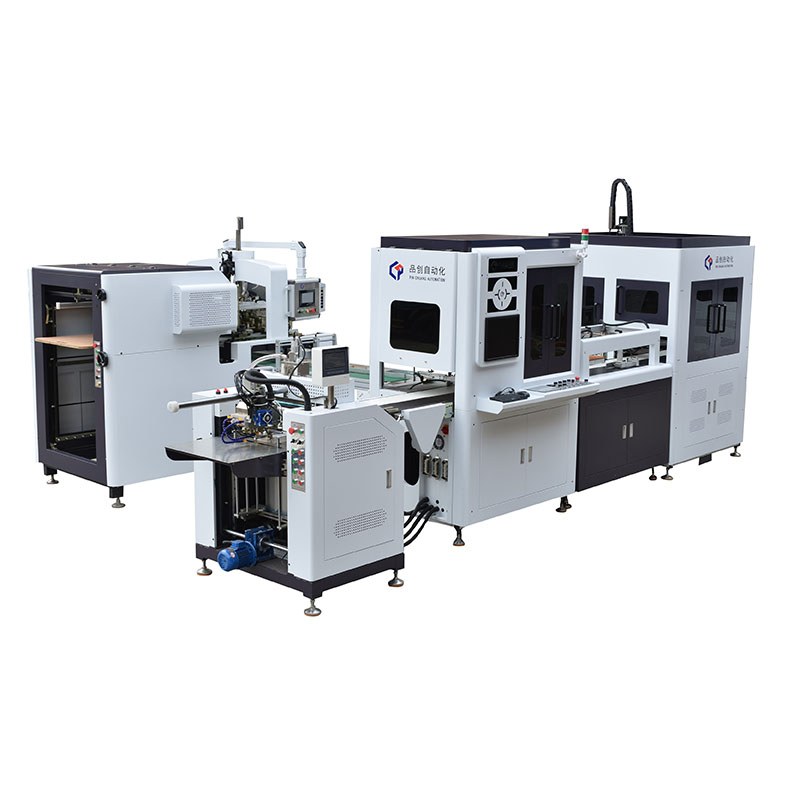
An automatic rigid box making machine manufacturer is chosen for the years after installation as much as for the machine itself. Speed and precision get a line started; spare parts, remote diagnostics and operator training decide whether it is still running at the same rate in year five.
At Pinchuang we build automatic rigid box equipment and support it in over 30 export markets, which gives us a particular view of this subject. This guide explains why support should drive the decision, which support commitments are worth writing down, how to read engineering capacity from the machine itself, and what belongs in the contract before you sign.
Why Support Decides Your Automatic Rigid Box Making Machine Manufacturer Choice
A rigid box line is a system of stations, each with wear parts that behave differently over time. Tape heads, forming moulds, glue rollers and pneumatic valves all have finite lives, and the moment one fails, the question becomes how quickly a replacement reaches your floor.
That question is answered long before the failure, at the moment you choose the supplier. Two manufacturers can quote identical specifications and produce machines that look the same in a photograph, and still differ enormously in the third year of operation. The difference is not quality as such; it is how well the builder knows its own product when something goes wrong.
There is also a commercial dimension. A line that is unavailable for a week costs output that no negotiation recovers. Where the support route is defined and the wear parts are known, most faults resolve inside a day; where it is not, a simple failure can idle a plant while emails circulate.
Support That Actually Matters
Four support functions carry most of the weight. Ask about each one separately, because they are delivered by different teams and are easy to bundle into a vague promise.
Spare parts
Ask for an itemised first-year parts list, station by station, with part numbers that appear on the machine drawing. Then ask which of those items are standard commercial components available locally in your country. Components such as pneumatic valves and drive units can often be bought regionally, while tooling and moulds almost always come from the builder, so knowing which is which shortens every future purchase.
Remote diagnostics
Modern controls report fault codes, and a supplier that can read those codes over a screen share is worth a great deal. Ask who answers a technical question and in what role. A sales office forwards; an engineering team diagnoses. If the answer to a fault is always “send a photograph”, the support route is not really technical.
Engineer visits
Clarify what is included at commissioning and what is chargeable afterwards. Ask about the typical response window for a visit, and be realistic about geography: the same commitment means different things for a plant four hours away and one four flights away.
Training
Training should be measured in changeovers, not hours. What matters is whether your operators can move from one box size to another and repeat the setting a month later. Ask for a documented changeover sheet per size, and for the trainer to sign off each size your team runs unaided.
Judging Engineering Capacity from the Machine Itself
You do not need a factory tour to assess engineering capacity. The machine tells you most of it if you know where to look.
| What you look at | What it tells you |
|---|---|
| Positioning system | Whether the builder integrates vision and motion control itself or buys a package |
| Tooling family | Whether several models share moulds, which is only possible if one team designed them |
| Control documentation | Whether the software revision is tracked and supportable years later |
| Line compatibility | Whether the builder can match a second station to a machine you already own |
Take positioning precision as the clearest single indicator. A platform fitted with a robot reading printed marks and correcting position before gluing holds around ±0.1 mm, against roughly ±0.50 mm for purely mechanical referencing. Building that capability requires a visual positioning machine to be engineered as a system, not assembled from parts, and the same team is the one you will call in year three.
The tooling question is a close second. If a manufacturer builds one frame in several configurations and shares the mould family across them, its drawings and its parts store are organised. A plant adding capacity later can bolt a second station into the same line rather than starting again — a double-station machine alongside an existing single-station platform, for example.
What to Write into the Contract
Support promises are worth only what the contract says, and three clauses carry almost all of the risk.
- Specification with conditions. Box size range in all three dimensions, board thickness, wrap weight, positioning method and tolerance, plus the electrical configuration for your destination. A speed figure without these conditions cannot be enforced.
- Tooling scope. Which moulds are included, which are chargeable, and the drawing reference for each one. Tooling is where an attractive offer is quietly recovered, and it is also what your operators touch every day.
- Acceptance criteria. The box sizes to be run, the materials to be used, the speed to be sustained and how many pieces are produced before sign-off. Written acceptance turns a test run into a measurable event instead of an opinion.
Pinchuang has built automatic rigid box equipment in Dongguan since 2008, manufactures in a 10,000 m² facility with more than 100 employees, and supports machines in over 30 countries. We exhibit at All in Print China, Printing South China, China Print, Drupa, SINO FOLDING CARTON and WEPACK.


Both sit on the same rigid box making machine platform and share a tooling family, which matters for support: one parts list, one set of changeover sheets, one technical contact. Where the line continues past forming into final assembly, a box assembly machine from the same builder keeps the support route intact, and combinations we are asked for most often are collected on the applications page.
Commissioning: The First Two Weeks Decide a Lot
Most support problems are created during commissioning and only appear months later. Three habits during installation prevent them.
Record the settings. Every box size you run during commissioning should be photographed at the control panel, with the values written onto the changeover sheet while the engineer is still on site. Notes taken later from memory are the origin of most size-change problems.
Record the baseline. Ask for the reference values for glue film, forming pressure and tape position on a piece of your standard stock, so that when quality drifts in six months you have something to compare against rather than an impression.
Then run the machine on your own. Before the engineer leaves, have your operators complete at least two size changes unaided while someone watches. A changeover that has only ever been performed by the installer is not yet a capability your plant possesses, and discovering that a month later costs far more than an extra day of commissioning.
Common Questions About Long-Term Support
How soon should a supplier reply to a fault report?
Agree a first-response window in writing, and separate it from the time to fix. A first response that identifies the likely cause and the part needed is what gets a line running; the part then travels. Suppliers who only promise “a fast reply” have promised nothing measurable.
Which spare parts should I stock myself?
Start with the consumables you already know you will replace: tape heads on the corner pasting station, glue rollers, forming mould wear pads and standard pneumatic valves. Add one of each critical sensor. Everything else can be ordered against the parts list, which is another reason to insist that the list carries part numbers.
Does operator training reduce downtime more than better parts?
Usually yes, at least in the first two years. Most early stoppages come from changeover rather than failure: the wrong mould setting, a glue setting carried over from another box, a wrap fed at the wrong tension. Documented changeover sheets fix that class of problem permanently.
Can support be transferred if I sell the machine?
Ask before you buy. It depends on whether the builder keeps records against the frame number and whether it will service a machine it did not sell new. A builder that tracks frame numbers can answer that question immediately, which is itself a good sign.
Send Pinchuang your box sizes, materials and target output. As an automatic rigid box making machine manufacturer we will reply with a configuration, a parts list and a written acceptance test — the three things that determine what happens after installation.
Ask about support terms Review our machine platforms