

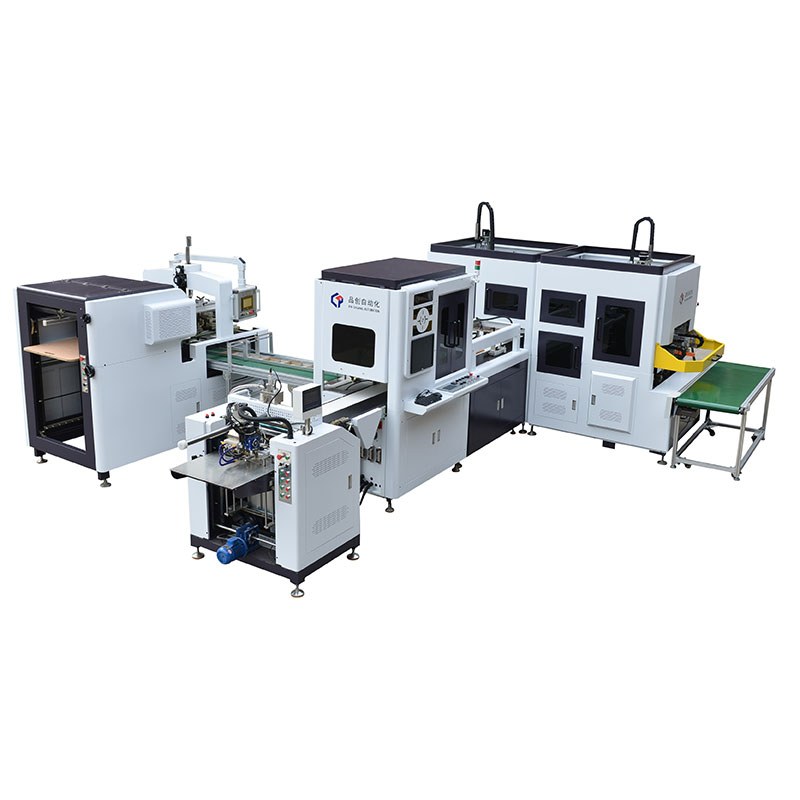
A rigid box making machine manufacturer should be judged on three things: whether it builds the machine itself, how deep its engineering goes when your box is not standard, and what happens in year three when a part wears out. Everything else in a quotation is decoration.
At Pinchuang we are on the supplying side of this conversation, so this guide is written as a checklist rather than a sales pitch. It sets out what a buyer can actually verify before placing an order — what to ask for, what to inspect, and which answers separate a manufacturer from a trading company that has a factory photograph on its website.
Six Things to Verify in a Rigid Box Making Machine Manufacturer
None of these checks requires a flight. Four can be done over email and video before you ever discuss a contract.
- Who owns the assembly hall. Ask for a live video walkthrough of the bay where the machine is being assembled, not a downloaded brochure. A manufacturer can show you the frame being welded and the motion control cabinet being wired.
- Whether the core stations are built in-house. On a rigid box platform the critical assemblies are the positioning unit, the wrapping and forming stations and the control system. A supplier that buys all three has no way to change them when your box needs something unusual.
- Tooling capability. Ask what happens if your box falls outside the standard range by 20 mm. A manufacturer answers with a modification and a drawing. A trader answers with a different model number.
- Spare parts policy. Ask which wear parts they hold in stock, and how quickly a corner pasting tape head or a forming mould can be dispatched. This is the cheapest question to ask and the most expensive one to skip.
- Reference installations that match your product. Not a list of countries, but two or three plants running boxes in your size band and material. Ask for the box specification, not the customer name.
- Who answers the technical questions. If every answer routes through a sales person who has never set up a machine, you will feel it the first time the line stops at 2 a.m.
In-House Manufacturing vs Trading: How to Tell Them Apart
The difference shows up in four places, and each one is observable from outside the company.
| What you check | Manufacturer | Trading company |
|---|---|---|
| Answering a custom size | Offers a modification with a sketch | Offers the nearest catalogue model |
| Machine identity | One platform, several configurations | Many unrelated brands in one list |
| Documentation | Manual, drawings and wiring schedule match the frame number | Generic manual, often for a different model |
| Parts follow-up | Can describe the part and its revision | Asks you to send a photograph |
One quick test: ask what the frame number on the machine means, and what it tells them about the configuration. A manufacturer answers immediately. A trader stalls. On our own rigid box platform, the same frame is built as a high-speed version and as a shorter basic version, which is only possible if the builder owns the design.
Engineering Depth: Tooling, Motion Control and Custom Sizes
Engineering depth is hard to judge from a specification sheet, because a sheet only tells you what a machine does at its best. It is easier to judge by asking what the machine does at its edges.
Tooling
Ask how a mould is made and how long a replacement takes. Boxes are sold by size band, and the tooling for a 65 × 65 mm box is a different piece from the tooling for a 500 × 400 mm one. A manufacturer will talk about tooling drawings and changeover procedure; a trader will talk about lead time only.
Motion control
Positioning precision is the number that separates one machine from another on the shop floor, because it decides how much waste you generate on patterned wraps. Mechanical referencing typically holds around ±0.50 mm. A platform fitted with a Yamaha robot reading printed marks reaches ±0.1 mm, and machines built on that platform stay inside the tight band after a size change. A visual positioning machine is the clearest evidence of real motion control engineering, because it needs the controls, the vision system and the mechanics to work together.
Custom sizes
Send a drawing for a box that sits just outside the published range and watch the reply. The answer you want is a specific limit on their side — a maximum board size, a minimum turn-in depth — plus a statement of what would have to change. Precision about limits is what engineering depth sounds like. Vagueness is what a reseller sounds like.
Support to Lock In: Spare Parts, Training and Remote Help
Support is the part of the purchase that is hardest to renegotiate later, so it should be settled before the machine ships rather than after the first breakdown.
| Support area | What to agree in writing |
|---|---|
| Spare parts | A recommended first-year parts kit, itemised by station, with the part numbers on the machine drawing |
| Training | Operator training on your own box sizes, plus a documented changeover procedure for every size you run |
| Remote help | Screen-sharing or video support with an engineer who can read the control system diagnostics |
| Acceptance | Written test-run criteria: box sizes, board and paper used, speed held, and how many pieces run before sign-off |
Two Mistakes That Cost Buyers Time
The first mistake is buying a machine for the boxes you make in a good month rather than the boxes you make every month. A plant that quotes its peak order as the design point usually ends up with capacity it cannot feed, and a machine that runs at half load holds precision less consistently than one running inside its normal band. Ask the manufacturer to size the machine against your median order, and to say plainly where the ceiling sits — on our rigid box range, the two-piece forming machine and the shorter basic version cover the same box sizes at different speeds, so the honest answer depends on how your order book is shaped.
The second mistake is treating every station in the line as an interchangeable purchase. Corner pasting, V-grooving, gluing, forming and final assembly each have their own throughput, and the slowest one sets the pace of the whole plant. If two of them come from different suppliers, responsibility for a bottleneck becomes a discussion instead of a fix. A manufacturer that builds the surrounding stations as well — a box assembly machine, a double-station machine for higher volume, and the auxiliary stations between them — can be held to one line performance figure rather than a set of separate ones.
Where a plant already owns equipment from several sources, it helps to see how similar line-ups are arranged elsewhere before deciding what to replace first. The applications page shows the combinations we are asked for most often, which is a faster starting point than assembling a specification from scratch.
Pinchuang has manufactured this equipment in Dongguan since 2008, with production in a 10,000 m² facility and more than 100 employees, shipping to over 30 countries. We exhibit at All in Print China, Printing South China, China Print, Drupa, SINO FOLDING CARTON and WEPACK.
Facts you can hold a supplier to, because they are verifiable at any time.


Common Questions About Choosing a Manufacturer
Is a factory visit necessary?
Useful, but not decisive. A live video walkthrough covering the assembly hall, the parts store and the test bay gives you most of the information, and it is much harder to stage than a prepared factory tour. If you visit, ask to see a machine mid-assembly rather than a finished one.
How many configurations should one manufacturer offer?
Enough to cover your size band honestly, and no more. A rigid box making machine manufacturer that lists twenty unrelated models is usually reselling. One platform built in several configurations — a high-speed version and a shorter basic version, for example — is the normal shape of a genuine product line.
What should the test run prove?
That the machine holds speed and precision on your board and paper, not on ideal stock. Ask for the run to use your sizes, and ask for the pieces to be packed with the machine so you can inspect them yourself rather than reading a report.
How do I judge a manufacturer I have not worked with before?
Ask one technical question you already know the answer to and see whether the reply is precise. Depth of engineering shows up fastest in small answers about limits, tooling and changeover, long before any commercial discussion begins.
Tell Pinchuang your box sizes, board thickness and target output. As a rigid box making machine manufacturer we will answer with a configuration, its limits and the tooling it needs — not a catalogue page.
Ask us a technical question Review the full build list