

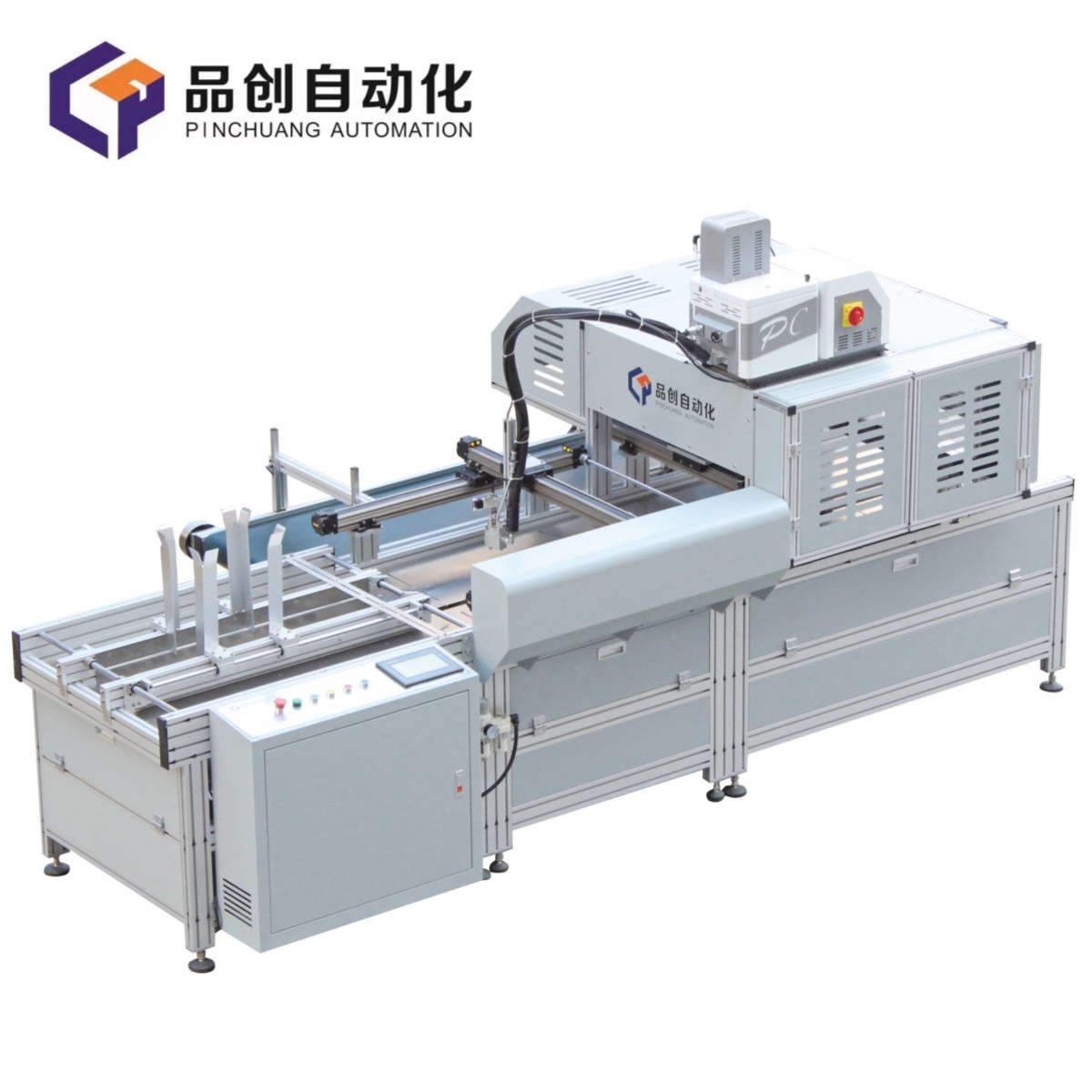
A rigid box making machine factory sells you the ability to change the machine, not just the machine itself. That is the practical difference between buying direct and buying through a reseller: when your box sizes move, the people who welded the frame and wrote the control sequence are the same people you are asking for a modification.
Pinchuang builds rigid box equipment in Dongguan and sells direct, so we have a clear interest in this subject. This guide sets out what a factory visit should actually show you, what direct sourcing changes in practice, how the dealer route differs, and what the test run before shipment ought to cover.
What a Rigid Box Making Machine Factory Visit Should Show You
Most factory tours are arranged around a finished machine in a bright bay. The informative parts of a factory are usually somewhere else, and a serious buyer should ask to see four areas.
- The assembly bay, mid-build. A frame being squared and a control cabinet being wired tells you more than a completed machine with the panels on. Ask how the frame is levelled and how the guide rails are aligned.
- The parts store. Racks of forming moulds, tape heads, glue rollers and pneumatic valves show what the builder actually stocks, as opposed to what it can order. Ask to see the parts for the station you are buying.
- The tooling area. Where moulds are machined and stored. This is the capability that decides whether an unusual box size is a small modification or an impossible request.
- The test bay. Where machines are run before shipment, and where your sample boxes should be produced. Ask to see the record sheet from a previous test.
If a visit is not practical, ask for a live video walkthrough of the same four areas. A recorded promotional video will not show you the parts store; a live call can.
What Factory-Direct Sourcing Really Changes
Direct sourcing changes three things, and none of them is the headline figure most buyers look at first.
The answer to a non-standard request
A modification request that reaches the design and tooling team directly comes back as a decision with a reason. Send the same request through a reseller and it passes through at least one translation of intent before anyone technical sees it. On a rigid box platform, the difference between “our machine does 65 × 65 mm minimum” and “here is what would have to change to go smaller” is the whole value of buying direct.
The parts trail
When a machine is built in one place, the part numbers on the drawing match the part numbers in the store, and a replacement can be ordered by number. That sounds mundane until a line stops on a Friday afternoon and the only way to identify a component is a photograph.
Accountability for line performance
If the forming station, the corner pasting station and the gluing station come from one builder, one party owns the throughput of the line. Where they come from three sources, a bottleneck becomes a discussion. A builder that supplies the surrounding stations — a forming machine, a paper gluing machine and a corner pasting machine alongside the box making platform — can be held to one output figure rather than three.
Factory-Direct vs Dealer: Communication, Parts and Modification
Dealers are not automatically a bad route, and in some markets they provide real local service. The point is to know which one you are dealing with, because the differences show up in specific places.
| Topic | Factory-direct | Through a dealer |
|---|---|---|
| Technical questions | Answered by the engineering team | Answered by a local sales office |
| Modification | Assessed against the drawing and tooling | Often limited to catalogue options |
| Spare parts | Ordered by part number from the builder | Depends on local stock and margin |
| Test run | Run on your sizes at the builder's bay | Sometimes run at a third site |
One question settles it in a single exchange: ask who signs off the machine specification, and ask for that person's role rather than their name. If the answer is an engineering role at the builder, the route is direct in the way that matters, even if a local agent handles the paperwork.
The Test Run: What Should Happen Before Shipment
The test run is the last chance to catch a problem while the people who built the machine are standing next to it. Four things should happen, and all four should be documented.
- Run your sizes, not the standard ones. A machine can hold speed and precision comfortably in the middle of its range and behave differently at the edges.
- Run your board and wrap. Greyboard thickness and wrap weight both change how a box behaves. Ask for the materials to be recorded on the test sheet.
- Hold the quoted speed. Ask for a sustained run at the specified rate and for the pieces to be kept, so the waste rate can be checked rather than estimated.
- Pack the samples with the machine. Having the test pieces arrive with your shipment lets you inspect them in your own light against your own quality threshold.
A builder that resists documenting the test run is telling you something. On our own platform the test sheet names the box size, board thickness, wrap weight, speed held and the settings used, because those numbers become the starting point for the changeover sheet your operators will use later.
Pinchuang has built rigid box equipment in Dongguan since 2008, manufactures in a 10,000 m² facility with more than 100 employees, and ships to over 30 countries. We exhibit at All in Print China, Printing South China, China Print, Drupa, SINO FOLDING CARTON and WEPACK.
What you would see on a walkthrough of the plant, stated plainly.


Both are built on the same rigid box making machine platform, which is the practical proof of factory-direct capability: one frame, two configurations, shared tooling and a modification path that runs back to the drawing. Line arrangements that combine them with other stations are collected on the applications page.
What Factory-Direct Does Not Change
Buying from the builder removes an intermediary, but it does not remove the work you have to do. Three responsibilities stay with you regardless of the route.
First, the specification. A direct order is only as good as the document behind it, because there is no reseller to blame for a misunderstanding. Write down box sizes, board thickness, wrap weight, positioning method, electrical supply and the acceptance criteria, and make sure the build is signed against that list rather than against a model number.
Second, the materials. The machine will be set up for the board and wrap you send. If your production stock differs from the samples — a different laminate, a heavier board, a new supplier — say so before the test run rather than after, because precision and speed figures move with the stock.
Third, the floor. Machine footprint, service access, air supply and operator position are your plant's constraints, not the builder's. Sending a floor plan with the enquiry costs nothing and prevents the most avoidable kind of delay: a machine that arrives and does not fit where the line was planned.
Common Questions About Factory-Direct Buying
Does buying direct mean no local support?
Not necessarily, and it depends on the builder. Ask what remote support looks like, whether an engineer travels for commissioning, and how parts are dispatched. Direct does not mean unsupported; it means the technical answers come from the company that made the machine rather than from a reseller's sales desk.
How can I tell a factory from a trading office?
Ask three questions in one message: how the frame is squared, what the parts store holds for your station, and who signs off the specification and in what role. A factory answers all three specifically and in the same email. A trading office answers one and forwards the other two.
What if I need a size outside the standard range?
Raise it before the order, with a drawing. Direct sourcing exists precisely for this situation, because the answer requires looking at tooling, board limits and turn-in depth together. Ask for the limit on the builder's side and what would change, rather than a yes or no.
Should I inspect before shipment?
Yes, whether by yourself, your agent or a third-party agency, and always against the specification you agreed. Inspection is far cheaper than correcting a machine after it has crossed an ocean and been bolted to your floor.
Send Pinchuang your box sizes and materials, and we will arrange a live walkthrough of the assembly bay and a test run on your own stock — the two things a rigid box making machine factory should never hesitate to show.
Book a live factory walkthrough View machines built in-house